Transformation 3ph->RRF
Purpose
Transform 3-phase signal to rotating reference frame
Library
Control / Transformations
Description

This block transforms a three-phase signal \([x_\mathrm{a}\; x_\mathrm{b}\; x_\mathrm{c}]\) into a two-dimensional vector \([x_\mathrm{d}\; x_\mathrm{q}]\) in a rotating reference frame, optionally extended by the zero-sequence component \(x_\mathrm{0}\). The first input is the three-phase signal. The second input is the angle \(\theta\) of the \(d\)-axis, measured counter-clockwise from the \(a\)-axis. \(\theta\) is given in radians.
The zero-sequence component \(x_\mathrm{0}\) is only included if the Zero-sequence component parameter is set to on. Otherwise, \(x_\mathrm{0}\) is omitted from the output vector together with the corresponding row of the transformation matrix, i.e. any zero-sequence component in the three-phase signals is discarded.
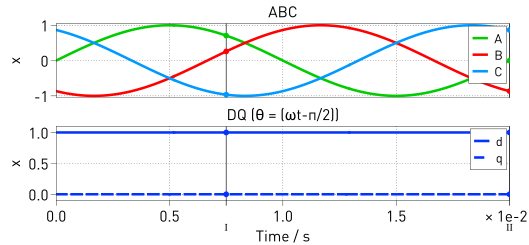 a)
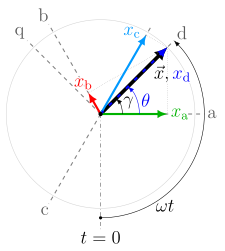 b)
Fig. 194 Graphical representation of \(abc\) frame to rotating reference frame transformation at cursor I, \(t=0.0075\) s, \(\omega t = 135^\circ\), \(\gamma = 45^\circ\), and \(\theta = 45^\circ\).
Note
The rotating reference frame transformation follows the axis alignment and rotation direction conventions presented in Conventions & Definitions.
Parameters
- Zero-sequence component
When set to
on, the zero-sequence component \(x_\mathrm{0}\) is appended to the output vector as third element. When set tooff, the output is a two-dimensional vector and any zero-sequence component in the three-phase signals is discarded. The default isoff.↳ Added in PLECS 5.1.