Transformation SRF->RRF
Purpose
Transform vector from stationary to rotating reference frame
Library
Control / Transformations
Description

This block transforms a two-dimensional vector \([x_\alpha\; x_\beta]\) in the stationary reference frame into a vector \([x_\mathrm{d}\; x_\mathrm{q}]\) in a rotating reference frame. The first input is the vector \([x_\alpha\; x_\beta]\), optionally extended by the zero-sequence component \(x_\mathrm{0}\). The second input is the angle \(\theta\) of the \(d\)-axis, measured counter-clockwise from the \(\alpha\)-axis. \(\theta\) is given in radians.
The zero-sequence component \(x_\mathrm{0}\) is only included if the Zero-sequence component parameter is set to on. In this case, it is passed to the output unchanged. Otherwise, \(x_\mathrm{0}\) is omitted from both vectors together with the corresponding row and column of the transformation matrix.
 a)
 b)
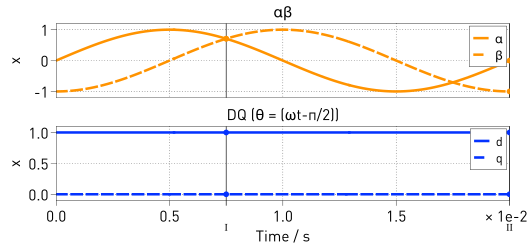
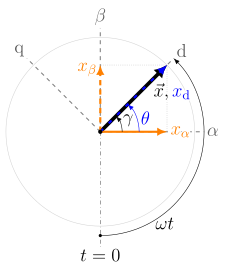
Fig. 199 Graphical representation of stationary reference frame to rotating reference frame transformation at cursor I, \(t=0.0075\) s, \(\omega t = 135^\circ\), \(\gamma = 45^\circ\), and \(\theta = 45^\circ\).
Note
This transformation follows the axis alignment and rotation direction conventions presented in Conventions & Definitions.
Parameters
- Zero-sequence component
When set to
on, the first input and the output are three-dimensional vectors whose third element, the zero-sequence component \(x_\mathrm{0}\), is passed through unchanged. When set tooff, the first input and the output are two-dimensional vectors. The default isoff.↳ Added in PLECS 5.1.