Transformation RRF->SRF
Purpose
Transform vector from rotating to stationary reference frame
Library
Control / Transformations
Description

This block transforms a two-dimensional vector \([x_\mathrm{d}\; x_\mathrm{q}]\) from a rotating reference frame into a vector \([x_\alpha\; x_\beta]\) in the stationary reference frame. The first input of the block is the vector \([x_\mathrm{d}\; x_\mathrm{q}]\), optionally extended by the zero-sequence component \(x_\mathrm{0}\). The second input is the angle \(\theta\) of the \(d\)-axis, measured counter-clockwise from the \(\alpha\)-axis, i.e. from the axis of phase \(a\). \(\theta\) is given in radians.
The zero-sequence component \(x_\mathrm{0}\) is only included if the Zero-sequence component parameter is set to on. In this case, it is passed to the output unchanged. Otherwise, \(x_\mathrm{0}\) is omitted from both vectors together with the corresponding row and column of the transformation matrix.
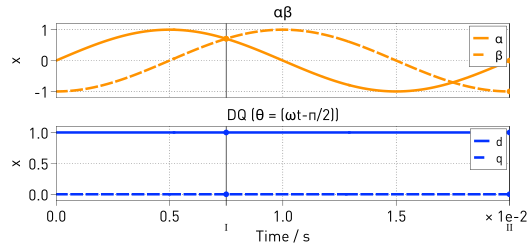 a)
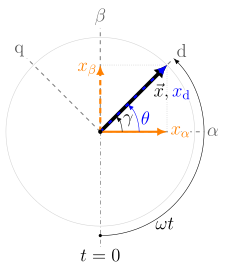 b)
Fig. 194 Graphical representation of rotating reference frame to stationary reference frame transformation at cursor I, \(t=0.0075\) s, \(\omega t = 135^\circ\), \(\gamma = 45^\circ\), and \(\theta = 45^\circ\).
Note
This transfomation follows the axis alignment and rotation direction conventions presented in Conventions & Definitions.